
1 min read
Episode 2: Difficult Stakeholder Dynamics
In this episode of The Life Science Lawcast, Wendy Lloyd Goodwin is joined by Rebecca Clothier to discuss the relationship between in-house legal...
Our life science legal experts regularly review hundred's of legal, compliance, and data privacy updates.
We curate this content into our fortnightly Regulatory Update for you to stay informed of recent changes. Click here to read the latest update.
2 min read
Wendy Lloyd-Goodwin
:
Updated on November 13, 2026
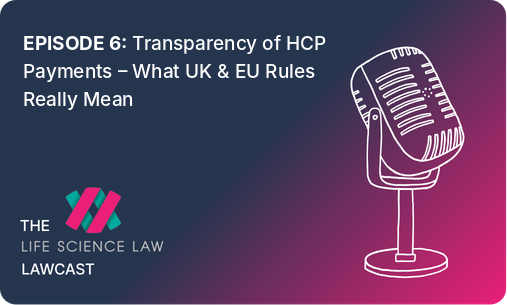
In this episode of The Life Science Lawcast, Wendy Lloyd Goodwin is joined by Alexandre one of Life Science Law’s Senior Compliance Consultants, and former Deputy Chief Ethics & Compliance Officer at Servier. Drawing on Alexandre's extensive compliance experience, they explore the evolving landscape of HCP payment transparency across the UK and EU, and what organisations need to consider when navigating differing disclosure requirements.
________
The discussion starts with why HCP transparency matters more now than it did five years ago. Independent projects such as Euros for Docs now pull country-by-country disclosure data into a single database, so inconsistencies are visible to journalists, regulators, competitors and claimants’ lawyers. Wendy and Alexandre then look at the difference between a programme that files on time and one that would survive being checked by someone else. Alexandre sets out six markers of a mature programme, using examples from the EFPA, Disclosure UK, France and Italy, and shares three questions compliance leads can use to test their own programme. The episode closes with practical next steps for organisations that don’t like the answers.
Listen to Episode 6 of The Life Science Lawcast here or via your usual podcast platform.

________
Categorisation is a choice: Differences in R&D reporting between countries reflect how payments are categorised, not how much research is done.
Legitimate interest is changing the picture: Moving from consent to legitimate interest drove a sharp rise in named UK disclosures.
Europe is still fragmented: There is no single EU transparency regime, so consistency across countries is down to each company.
________
1. Ownership and data capture
One senior person should own the whole process end to end. Engagement data should be captured when the decision to engage is made, not pieced together from emails before the deadline.
2. Contract design
Agencies, CROs, events companies and homecare providers should be contractually required to give named, itemised beneficiary data, and the contract should state who is responsible for disclosure.
3. Reconciliation as a routine, not an event
Reconcile against contracts, accounts payable, expense reports and third-party statements on a recurring basis, not once in a rush before the deadline. The test: can you reproduce a two-year-old figure from source evidence by tomorrow?
4. Cross-jurisdiction consistency and the register as a diagnostic
Record each engagement once as a single fact, then apply each country’s rules. Once published, review your data as an outsider would, checking for duplicate entries and unexplained spikes.
5. Where to start
Score yourself honestly against all six markers, get an outside view, and turn the validated gaps into a plan with an owner and a date for each. Only then decide how much hands-on support you need.
________
“Five years ago, nobody has assembled the data to check. Now it has been done once by an outside party with no obligation to be kind about what it finds."
“We have never missed a deadline… that’s an administrative achievement. It’s not a governance one."
“If this is the second, then you don’t have a control. You have a deadline.”
This episode shows that HCP transparency is no longer just about filing on time. With disclosure data now aggregated and visible to anyone, the question is whether your programme would hold up if someone else went looking. Clear ownership, well-designed contracts and routine reconciliation are still the best protection. You can try our self-assessment diagnostic tool against the six markers and explore articles, case studies and upcoming events in the Knowledge Centre on our website.
Have a question or perspective on this topic?
We’d be interested to hear your thoughts. Share your comments using the form below and join the conversation.
1 min read
In this episode of The Life Science Lawcast, Wendy Lloyd Goodwin is joined by Rebecca Clothier to discuss the relationship between in-house legal...
1 min read
In this episode of The Life Science Lawcast, Wendy Lloyd Goodwin speaks with Rebecca Clothier about developing a career within an in-house legal...
1 min read
In this episode of The Life Science Lawcast, Wendy Lloyd Goodwin is joined by Rebecca to discuss how in-house legal teams balance legal risk with...